
Guide
Smart toilets: do they really clean better than toilet paper?
· Equipo Elora
Water vs. paper: the quiet change that improves everyday hygiene
The most common question we are asked about Japanese smart toilets is always the same: "Do they really clean well with water?" It is a legitimate concern. For generations we have used toilet paper, so trusting a jet of water can seem risky or unhygienic.
The short answer is: yes, they clean better. Infinitely better.
The long answer is: toilet paper never truly cleaned. It only smears and spreads. Water is the only method that actually removes bacteria and residue and leaves a feeling of absolute cleanliness.
And it is not just us saying it: it is backed by scientific evidence, the experience of millions of users worldwide, and something as simple as common sense. If you got mud on your hand, would you clean it by rubbing with dry paper, or would you wash it under running water?
In this article, you will discover:
✓ Why water cleans better than paper
✓ How water cleaning in a smart toilet really works
✓ Which problems it solves that paper could never solve
✓ All the benefits beyond simple cleaning
✓ Why models like ELORA AURA or ESENZA make the difference
If you would like an overview of smart toilets, read the main smart toilet guide.
Why does water clean better than anything else?
Think about this: if you got mud on your hand, would you clean it by rubbing with dry paper, or would you wash it with water? The answer is obvious. So why do we still use toilet paper for the most delicate area of our body?
Water is the oldest, most effective, and most natural cleaning method there is. It does not move dirt from one side to the other: it dissolves it, removes it, and washes it away completely.
Science confirms it: water vs. paper
Multiple studies have shown that cleaning with water removes bacteria and fecal residue far more effectively than toilet paper. A study conducted in a nursing home found that bidet users had significantly fewer bacteria in the urogenital area than those who used paper only.
Why? Toilet paper does not clean: it spreads. It drags fecal matter, smears it over the skin, and leaves residue. No matter how soft it is, no matter how many times you wipe, microscopic traces of bacteria always remain. Always.
Water, by contrast:
✓ Dissolves and washes away fecal residue completely
✓ Removes bacteria instead of redistributing it
✓ Reduces hand contact with fecal matter (less germ spread)
✓ Cleans without friction, protecting sensitive skin
✓ Leaves a truly clean feeling, not just "acceptable"
In simple terms: better hygiene, fewer infections, better health.
How water cleaning in a smart toilet really works
What it is and how it works:
A Japanese smart toilet is not simply "spraying you with water". It is a precision-engineered cleaning system:
1. Adjustable-pressure water jet.
The water comes out at the exact pressure needed to clean effectively without causing discomfort. You can adjust it to your preference: gentler for sensitive days, stronger for a deep clean.
2. Controlled water temperature.
Warm water (35–40°C) is not only more comfortable: it is more effective at dissolving residue and cleaning. It is like washing dishes: hot water cleans better than cold.
3. Precise nozzle positioning.
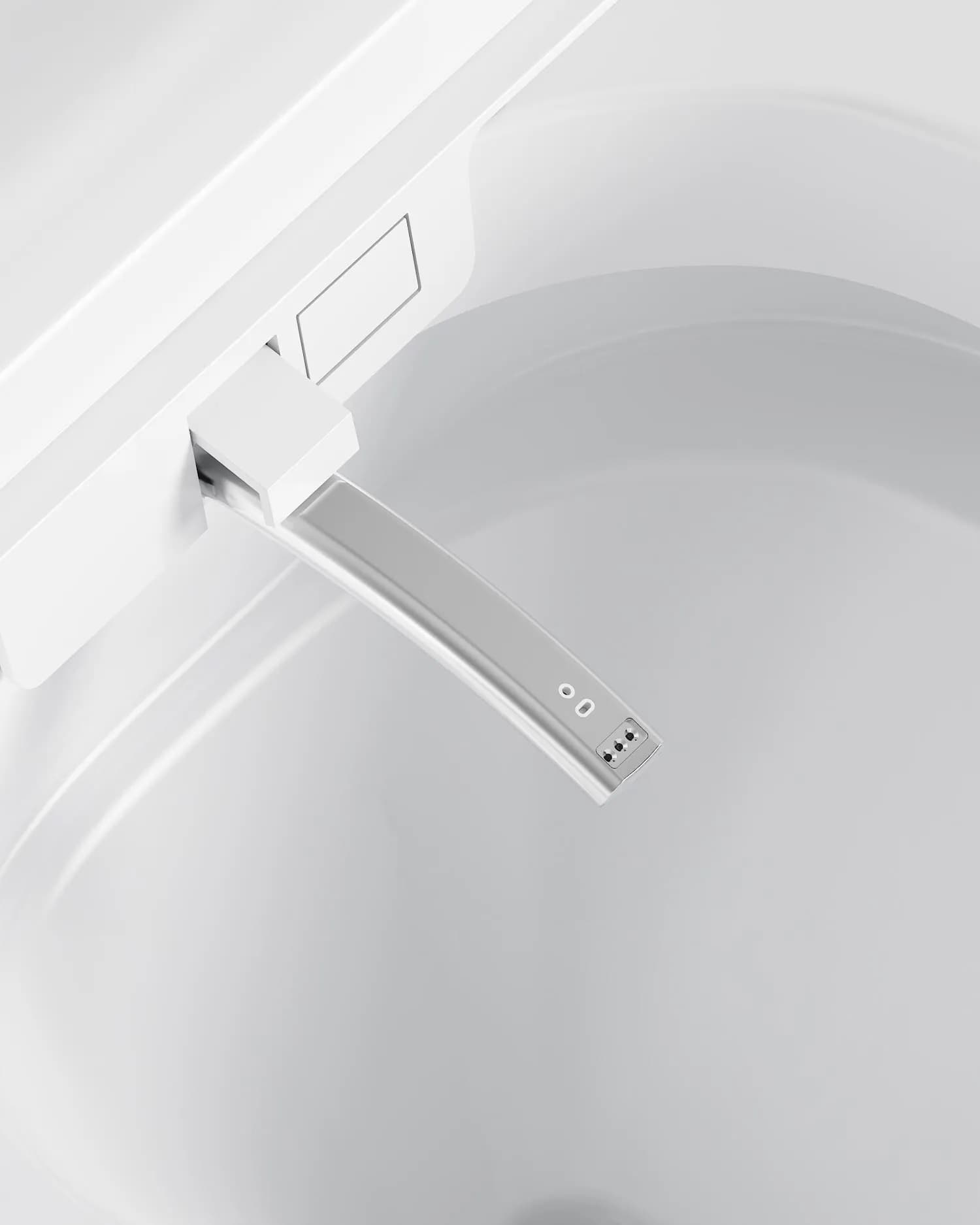
The nozzle extends and automatically positions itself at the exact angle to reach the entire area to be cleaned. You do not have to "aim" or balance yourself: the system does it for you.
4. Specialized cleaning modes.
- Rear mode: for complete anal cleaning
- Feminine mode: with a specific nozzle position for front intimate hygiene
- Massage mode: pulsating jet that stimulates circulation (ideal for hemorrhoids)
- Kids mode: pressure and temperature adapted for children
5. Self-cleaning nozzles.
The nozzles self-disinfect with water and UV light, so they always stay clean.
Why water temperature and pressure matter (a lot)
Not all water cleans the same. The effectiveness of water cleaning in a smart toilet depends on two key factors: temperature and pressure.
Water temperature: 35–40°C
Why warm water and not cold? Basic physics:
- Hot water dissolves fats and organic residue much better than cold water
- It is more comfortable for sensitive skin (cold water causes muscle contraction)
- It has a relaxing effect on the anal muscles, relieving tension and spasms
- Improves local blood circulation, supporting tissue health
It is the same principle as washing dishes with hot water: it cleans better.
Water pressure: adjustable between 0.3–0.6 liters/minute
The right pressure makes the difference between "getting wet" and "cleaning deeply":
- Low pressure: gentle cleaning, ideal for very sensitive skin, postpartum, surgeries, hemorrhoids...
- Medium pressure: standard daily cleaning, the perfect balance
- High pressure: deep cleaning, maximum fresh feeling.
ELORA toilets allow you to adjust both settings from the remote control. You decide how clean you want to feel every day.
For people with hemorrhoids or anal fissures
If you have ever had hemorrhoids, you know that cleaning yourself with paper is outright painful. Every wipe is torture.
Water changes this radically:
- Zero friction: the jet cleans without touching, rubbing, or aggravating inflamed tissue
- Soothing effect: warm water relaxes the anal muscles and improves circulation
- Less pain: clinical studies confirm that hemorrhoid patients report much less pain when using a bidet vs. paper
- Better recovery: without the constant irritation of paper, hemorrhoids heal faster
Gastroenterologists are clear: water cleaning is infinitely gentler and recommended for any condition involving intimate sensitivity.
For people with Crohn’s disease, ulcerative colitis, or irritable bowel syndrome
When you go to the bathroom 8, 10, 15 times a day during a flare-up, toilet paper becomes your enemy:
- It irritates you until your skin is raw
- It causes perianal dermatitis (red skin, burning, cracks)
- It hurts so much that you avoid cleaning properly... which causes more problems
- Simply going to the bathroom becomes suffering
Water eliminates all of this. It cleans without irritation, without rubbing, without pain. For these people, a smart toilet is not a luxury: it is regaining dignity and quality of life.
For postpartum women
After a vaginal birth, especially with an episiotomy or tears, cleaning yourself with paper is:
- Painful (the rubbing on stitches is unbearable)
- Risky (you can infect the wound with bacteria from the paper)
- Stressful (every bathroom visit is frightening)
Warm water, by contrast:
✓ Cleans without touching the wound
✓ Relieves pain with its soothing effect
✓ Reduces the risk of infection
✓ Supports faster recovery
Many midwives and gynecologists already recommend portable bidets for postpartum care. A smart toilet is the ultimate version.
For older adults or people with reduced mobility
Cleaning yourself properly with paper requires:
- Strength in hands and arms
- Flexibility to reach properly
- Balance to avoid falling
- Dexterity to avoid getting dirty
Many older adults lose independence in the bathroom precisely because of this. They need help with something as intimate and basic as cleaning themselves.
Water restores independence: you only need to sit down and press a button. The toilet does the rest. Independence, dignity, self-esteem.
And what about the feeling? Do you really end up clean with water?
This is the question everyone asks before trying a smart toilet. And the unanimous answer from those who use it is: you end up MUCH cleaner than with paper. Far cleaner.
The feeling is:
- Total freshness: like you have just stepped out of the shower
- Complete cleanliness: no more "Am I okay?" or "one more wipe just in case"
- Immediate comfort: no rubbing, no pain, no discomfort
- Confidence: you know you are truly clean, not just "presentable"
100% of people who try a smart toilet with water cleaning say the same thing: "I cannot go back to paper. It is like going back to the Stone Age".
Water vs. toilet paper: the comparison that changes perspectives
What toilet paper does NOT do (and what no one told you)
For decades, we have normalized cleaning ourselves with dry paper. But let us be brutally honest about what toilet paper really does:
❌ It does not remove bacteria: it redistributes it on your skin
❌ It does not clean deeply: it only drags surface residue
❌ It is not gentle: it causes friction, micro-abrasions, and pain on sensitive skin
❌ It is not hygienic: your hands come into direct contact with fecal matter
❌ It is not sustainable: cutting down trees for something you use for 5 seconds
❌ It is not economical: you spend €150–€300 a year, continuously
❌ It is not comfortable: if you have any intimate condition, it is outright painful
What water DOES do (and why it is objectively superior)
✓ It truly removes bacteria: water washes away and dissolves; it does not redistribute
✓ It cleans thoroughly: it reaches all folds and areas
✓ It is gentle on the skin: zero friction = zero irritation
✓ It is hygienic: minimal hand contact with residue
✓ It is sustainable: water you would use anyway, with no waste
✓ It is economical: a one-time investment that pays for itself in 3–5 years
✓ It is therapeutic: warm water soothes, relaxes, and supports circulation
The question that changes everything: would you trust paper alone to clean yourself?
Imagine something gets on your hand: mud, food, whatever. Would you clean it with dry paper only? No, would you? You would use water and soap without hesitation.
Now imagine you go for a run, sweat a lot, and when you get home someone tells you: "Do not shower, just wipe yourself with paper wipes." Would you feel clean? Comfortable? Of course not.
So why do we accept that dry paper is enough for the most delicate and infection-prone area of our body?
The answer is simple: because it is what we have always done. But "it has always been done this way" does not mean it is right, hygienic, or healthy.
Why 80% of households in Japan use water-cleaning toilets (and it is no coincidence)
Japan is one of the countries with the highest life expectancy in the world. It is also the country where smart toilets with water cleaning have been completely normal for decades.
Coincidence? Not exactly.
Japanese culture values hygiene, comfort, and disease prevention. They understand that proper intimate hygiene is preventive health, not a luxury. And that is why using water is not "being fancy": it is being smart about your body.
In Europe, we are still discovering it. But those who try water cleaning never go back to paper. Never.
Conclusion: Your bathroom deserves this revolution (and so do you)
A Japanese smart toilet is not just an appliance: it is an investment in your health, your comfort, and your daily quality of life. Every day, several times a day, for years.
Water cleaning is objectively superior to toilet paper: more hygienic, gentler, more effective. And when you add air drying, UV disinfection, therapeutic infrared light, and an elegant design, the result is a change you will notice from day one.
Ready to take the next step?
👉 Discover ELORA AURA: The complete premium experience
👉 Discover ELORA ESENZA: Launching March 2026
👉 Visit our showroom in Bertamiráns: Try before you decide
👉 Questions? Speak with an ELORA SMART advisor and we will guide you in choosing the perfect model for your bathroom:
Because what truly cleans is not technology. It is water. We simply turn it into an extraordinary experience.